

Daniele Procida
11 posts
Why are so many Canonical software tools named “craft”?
Introducing engineering practice leadership at Canonical

This year, UbuCon Africa takes place in Arusha, Tanzania. It’s co-located with DjangoCon Africa 2025 (11th-15th August) at Life Fitness Hall, Njiro. The whole event is five days of open source engagement and collaboration. There’ll be three days of talks, on programming, technology, careers, society and business, followed by two more of h

If you’re interested in applying for a role at Canonical, it can help to have some insider guidance. This article offers practical advice for candidates and some explanation to provide context. A lot has been written on social media about Canonical and our hiring processes. Some of it is even true. I share responsibility for
Typically, a technical writer takes the product created by a development team, and writes the documentation that expresses the product to its users. At Canonical we take a different approach. Documentation is part of the product. It’s the responsibility of the whole team. Documentation work is led by a technical author, who is part of the
DjangoCon Africa (Zanzibar, 6-11 November 2023) takes place for the very first time this year: a pan-African DjangoCon to join the family of DjangoCons that take place in Europe, the USA and Australia each year. Canonical will be sponsoring the conference, and we’ll be there with talks and workshops. Open-source software in Africa Our sup

Imagine if – as a job applicant – you could put yourself right in front of the hiring lead, and tell them, in your own words, in your own time, without interruption or distraction or pressure, why you think you’d be an excellent person for the role. What kind of applicant would benefit the most?

To help bring our ambitious documentation plans to fruition, we’re going to be hiring people to work in documentation – over the next couple of years, we’ll be increasing the number of Technical Authors at Canonical four-fold. This isn’t about documentation alone. If documentation is part of a product, and documentation work is part of

Sooner or later, almost everyone who looks at some software that they or their team have created imagines a user getting to grips with it, and a pang of empathy for that unknown person prompts them to think: what we need here is a tutorial. And they are always absolutely right. In the Diátaxis documentation
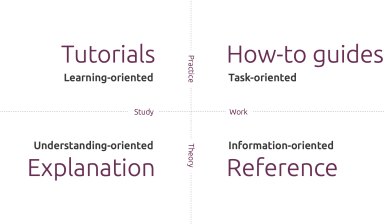
Our on-going documentation transformation project aims to make our documentation the best it can possibly be – an exemplar of excellence for the industry. We’re working on four distinct pillars of documentation to achieve this. The first of these pillars is direction. It defines what is quality in documentation, and answers the question:

Our software documentation is part of how we talk to each other – our users, our colleagues, our community. It’s a way we demonstrate how we value each other – including how we value you. We’ve understood the importance of this for some time, but actually finding a way to express those values in our