
Blog posts tagged "LXD"

22nd October 2020: Canonical today released Ubuntu 20.10 with optimised Raspberry Pi images for desktop in support of learners, inventors, educators and entrepreneurs, bringing the world’s most open platform to the world’s most accessible hardware. “In this release, we celebrate the Raspberry Pi Foundation’s commitment to put open computi
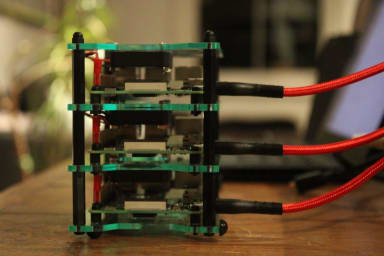
Set up and run your own homelab with the LXD Ubuntu Appliance. Spin up and manage virtual machines (VMs) and containers, run and test workloads across platforms and architectures, and rest assured of security and updates with Ubuntu Core. Follow the tutorial to get started or read on to learn why you might care. Why
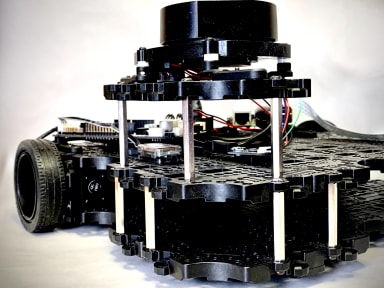
Interested in getting started in robotics? There’s no need to purchase expensive hardware before you try some things out: simulate a TurtleBot3 instead! The simulator is complete with LIDAR, a camera, a gyro and many other sensors and actuators. You can also see this installation in action at the Ubuntu Robotics YouTube channel. Software
In this post, we will see how we can containerize our home in LXD simply managing our personal configuration files – a.k.a. dotfiles. Yeah dotfiles, named after their common ~/.my_config form, you know, all of those small configuration files lying across our $HOME. In other words, how one can change the house while keeping the

Friction points in HPC DevOps Many High Performance Computing (HPC) setups are still handcrafted configurations where tuning changes can take days or weeks. This is because the more you tune and optimise something, the more bespoke and unique it is, and the more unique something is, the lower the chances that things will just work
It’s the season for updates. The last few weeks have ushered in ROS 1 Noetic and ROS 2 Foxy, both of which target the recently released Ubuntu 20.04 Focal Fossa. As always, new releases come with trepidation: how can I install new software and test compatibility, yet keep my own environment stable until I know

What’s new? This new release of MAAS brings three key new benefits: Virtual machines with LXD (Beta) Tighter, more responsive UX External/remote PostgreSQL database If you know what you want, go to maas.io/install, otherwise let’s dive in and explore these further. Virtual machines (VMs) with LXD (Beta) MAAS 2.8 can set up L XD-based VM
With more than 1.5 million global customers – including Sainsburys and Michelin – OVHcloud is Europe’s largest cloud computing provider, and the third largest web hosting company in the world. It goes without saying that storage is mission critical for an organisation like OVHcloud, but finding a solution that was compatible with their ex
Linux containers allow for easy isolation of developer environments. If you’re often working with a bunch of different ROS versions, it’s a lot easier to do your work entirely in containers. Getting Started You’ll first need to install LXD using snap. Note Throughout this guide I will be using the hostname to distinguish which machine

As developers, we do not always have access to a production-like environment to test new features and run proof-of-concepts. This is why it can be very interesting to deploy Kubernetes on a single machine. Of course, there is the new microk8s snap that allows a super fast deployment of a k8s cluster on a laptop
I needed to install a clean instance of Bionic to test some code, but I did not want to use a full virtual machine as I was in a hurry. To do this, I used LXD to quickly deploy new Bionic and Xenial instances in minutes. If you are not familiar with LXD, it is
LXD, the system container manager, developed by Canonical and shipped by default with Ubuntu, makes it possible to create many containers of various Linux distributions and manage them in a way similar to virtual machines (VMs) but with lower overhead costs associated with them. Unlike VMs, containers have the benefit of using a shared ke

“All my centurions develop using snaps.” Julius Caesar By and large, software development can be an enjoyable process. Until you hit the first error, that is. At that point, you want to get past the stumbling blocks as quickly as possible and resume building your apps. A robust, flexible development framework can make a big
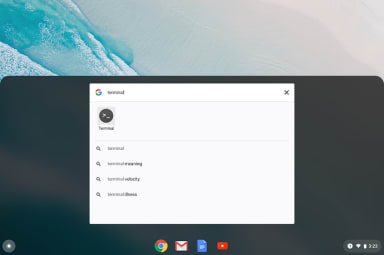
Introduction On supported Chromebook, starting with Chrome OS 69, a new feature called Linux Apps was introduced. This allows Chrome OS users, on supported to install normal Linux applications from the Debian repository and have them integrate with the underlying Chrome OS desktop. The feature has evolved quite a bit since its introductio

The appeal of Kubernetes is universal. Application development, operations and infrastructure teams recognise diverse reasons for its immediate utility and growing potential — a testament of Kubernetes’ empathetic design. Web apps, galvanised by the 12 factor pattern as well as microservice-structured applications find a native habitat in

Amazon Web Services (AWS) announced the availability of their new Amazon EC2 A1 instances powered by custom AWS Graviton processors based on the Arm architecture, which brings Arm to the public cloud as a first class citizen. Arm based processors provide a number of benefits in terms of density and power-consumption which ultimately resul